

Editor’s note: Certain visuals in this article are interactive but will render as static images in the email version. It is recommended to view them either in-browser or on the Substack app.
Thursday night, beneath the gilded ceiling of Flatbush’s once-abandoned Kings Theatre, Mayor Mamdani and Bernie Sanders headlined a get-out-the-vote rally. I sat wedged between two velvet ropes: one separating reserved seats from the general audience, the other guarding the backstage entrance. Placards marked each row for the entourage of a different Mamdani endorsee. An older man asked if I was Brad Lander’s daughter. In every direction, candidates fumbled with crinkled remarks sheets as aides hurriedly passed out posters and lawn signs. The stray unendorsed candidates lingered in the audience. Sara Bareilles sang “Brave”— stopping midway to ask us to clap on beats two and four instead of one and three.
A year ago, New Yorkers stood in polling places and filled in the oval beside Zohran Mamdani’s name. On Tuesday, they will vote again. His name will not appear on their ballots, but the coalition that elected him is being asked to recognize itself in eight others.
Those endorsees include part of the NYC-DSA slate and onetime rivals, slam dunks and heat checks. Almost all are seeking open seats— except the two congressional candidates facing incumbents. Together, they could reshape New York’s congressional delegation for a generation and deepen the Left’s bench in Albany.
Mayor Mamdani is a singular figure in New York politics. His endorsement carries weight, but not certainty. A candidate for mayor can promise to change the terms of everyday life. The candidates seeking to enter the halls of Washington and Albany must persuade voters that one more voice inside a legislature will help him to do it. That makes Tuesday not only difficult to forecast, but easy to misread.
By Wednesday morning, every race touching Mamdani’s coalition will have been spun as a referendum on him. If any endorsee falters— or even fellow travellers he declined to endorse— the distinctions will quickly disappear. Different districts, candidates, and conditions will be collapsed into a single headline about the limits of his influence.
Mayor Mamdani’s influence can be measured in several ways, and Tuesday’s results will not measure all of them equally. There is the power of his personal endorsement, the strength of the organizations that helped elect him, and the durability of the electorate his campaign expanded. The three overlap. They are not the same.
No reader of The Hudson Line has ever mistaken me for Walter Cronkite, and I am not approaching these races from a position of studied neutrality. I am involved with many of them in one form or another, though not as staff or a paid consultant. I was an elected member of NYC-DSA’s Electoral Working Group while most of its 2026 candidates navigated the endorsement process, and now serve on the Citywide Leadership Committee and Lower Manhattan Organizing Committee. Except for my own observations, what I write relies solely on public reporting and publicly available data.
Home Court
Before we turn to the candidates, it is worth looking at the ground beneath them. The chart below compares Mamdani’s first-round performance in last year’s mayoral primary with the share of voters who cast ballots for Hochul on the Working Families Party line in the last gubernatorial election.1 Neither is a perfect index of the Left. But together, they offer a rough picture of where Mamdani inherited an established progressive electorate and where he expanded beyond it.
Brownstone Brooklyn and the Upper West Side appear less hospitable to the mayor here than they really were. Brad Lander competed for many of the same progressive voters, depressing Mamdani’s first-round share without placing those neighborhoods outside the coalition that elected him.
The pattern is clearest when the congressional and legislative races are separated. Mayor Mamdani reserved his greatest risks for Washington, endorsing two challengers to incumbents, while his Albany slate is composed wholly of open-seat candidates. This leaves several broadly aligned challengers to test the strength of his coalition without him. A missing face on lit aside, Mamdani has remained comfortable appearing publicly with some of them, while endorsements from AOC and Bernie Sanders have kept most of the viable candidates within the coalition’s broader embrace.
Perhaps nowhere is Mamdani’s abstention more bruising than the cluster of AD-30, AD-38, and AD-54, where Shamsul Haque, David Orkin, and Christian Celeste Tate are running respectively. Haque co-founded the Bangladeshi American Police Association; Orkin, an immigrant workers’ rights attorney, and Celeste Tate, a community organizer, are endorsed by NYC-DSA. All three districts combine Commie Corridor strongholds with Hispanic and South Asian neighborhoods where Mamdani expanded well beyond the pre-existing progressive electorate, 60%+ first-round performances2 combined with middling WFP results in 2022. Haque is running in an open seat; Orkin and Celeste Tate are each running against incumbents whose defeat few would mourn. All three must lean on the fundamentals to carry the day.
“This is the Team”
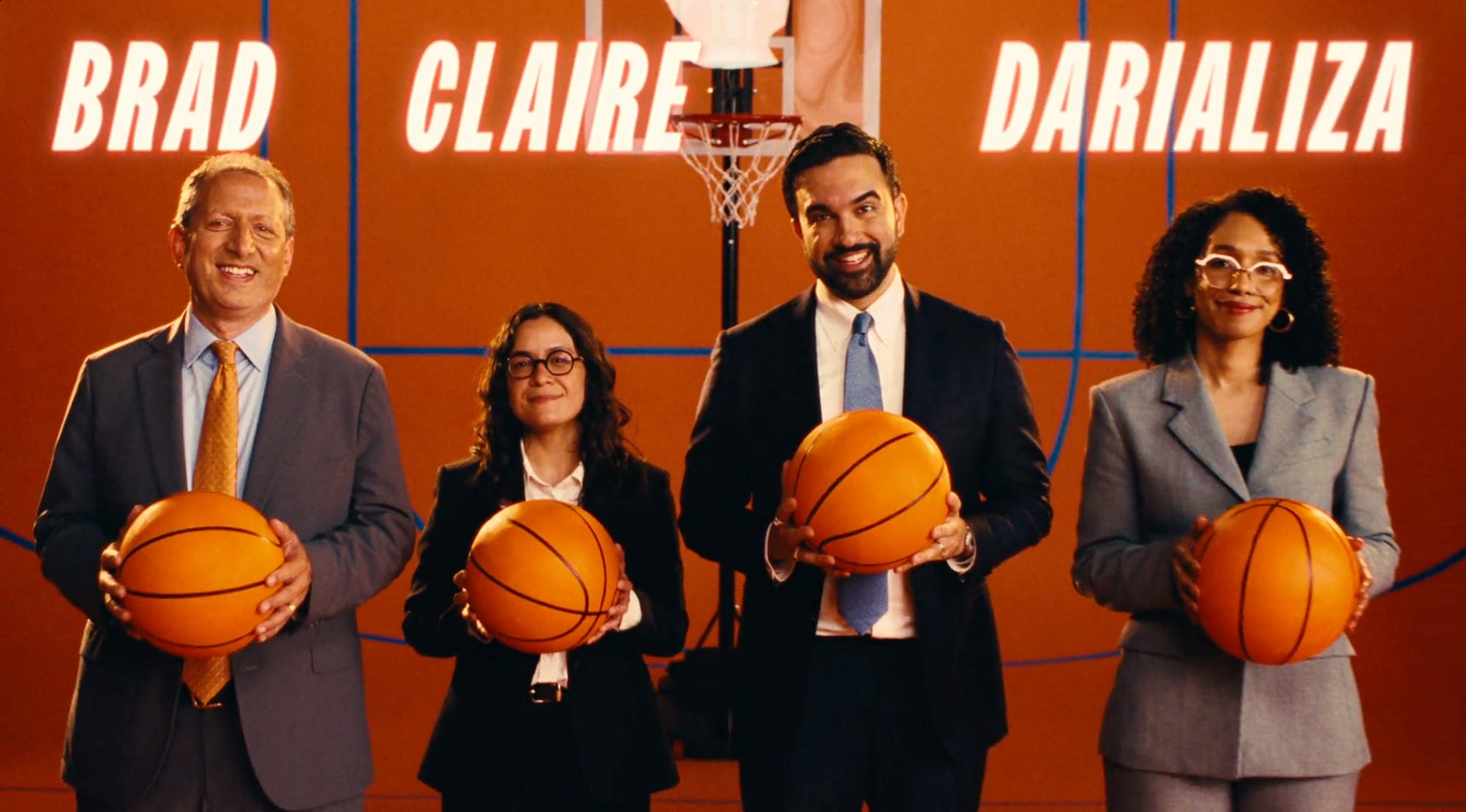
Minutes after the Knicks won Game 1 of the NBA Finals, New Yorkers watching the postgame commentary were introduced to another lineup. Mayor Mamdani stood beneath a basketball hoop beside Brad Lander, Claire Valdez, and Darializa Avila Chevalier, each dressed to the nines and holding a basketball. “This is the team,” he said. “This is our year.”
The Morris Katz-produced spot compressed three very different congressional campaigns into thirty seconds of coordinated passing and a shot that, for one glorious second, recalled the Saudi glowing orb photo. Lander promised to stop billionaires from buying elections; Avila Chevalier vowed to abolish ICE; Valdez pledged to take on landlords and greedy corporations. Together, they form the most visible and politically consequential part of Mamdani’s slate— and the least coherent as a singular electoral test.
The Slam Dunk
Not all fights are fair.
Dan Goldman came to represent Lower Manhattan and brownstone Brooklyn in 2022 as a moderate with a family fortune in a district crowded with renters, institutional progressives, lawyers— people who have made a point of resenting that sort of thing. His campaign rode a New York Times endorsement to a 26% plurality in a crowded field. The Times no longer offers endorsements in New York races.
Goldman only got 65% of the vote in the 2024 primary against two complete unknowns, a figure low enough to start the chatter. After the 2025 election, Yuh-Line Niou and NYC-DSA’s Alexa Avilés each briefly hovered around the race before Mayor Mamdani endorsed Brad Lander, the former city comptroller whose long career, cross-endorsement, and arrest at 26 Federal Plaza had earned him considerable goodwill among Mamdani voters. After a week or so of scattered grumbling, the race quickly consolidated around Lander.
Goldman has stacked endorsements from the governor, the city comptroller, unions, and many of his House colleagues. He has self-funded his campaign and enlisted a troupe of baby-faced T50 grads to staff it. The one constituency he has struggled to accommodate is his own.
His voting record has repeatedly supplied the evidence. Goldman was one of 22 Democrats to join Republicans in censuring Rashida Tlaib over her criticism of Israel. He later voted to reauthorize Section 702 surveillance powers, backed legislation applying a contested definition of antisemitism to federal civil rights legislation, and joined 44 other Democrats in supporting sanctions against officials of the International Criminal Court after they issued arrest warrants for Israeli leaders for war crimes and crimes against humanity. Perhaps most bewildering, he openly admitted to casting a write-in for the general election while his district backed the now-mayor by 25 points.
Lander’s advantage is older than Mamdani’s endorsement or even his rise to citywide office. For twelve years, he represented vote-rich Park Slope, Carroll Gardens, Cobble Hill, Windsor Terrace, Kensington, and neighboring parts of brownstone Brooklyn on the City Council, helping found its Progressive Caucus and building the sort of constituent services that survive term limits. In last year’s mayoral primary, he came within a point of Andrew Cuomo for second place in NY-10. The brownstones have a long memory.
Goldman is miscast to a near-comical degree. The numbers are unusually blunt. A May Emerson poll puts Lander ahead 57-23%, leading among every age group and by nearly five to one among voters under forty. Mamdani’s approval among Democrats in the district stood at 79%.
A breezy Lander victory would be the easiest of Tuesday’s to misread as proof of Mamdani’s transferrable power. The mayor’s endorsement mattered, especially for clearing the field, but it landed on top of thirty years of local relationships, a challenger often called a “pseudo-incumbent,” and an actual incumbent who has taken “vote your district” as a challenge.
The Fast Break
Open seats reward speed. By the time an establishment settles on an heir, an insurgent candidate can be halfway down the court.
When Nydia Velázquez announced her retirement on November 20, almost no one in New York politics had expected it. That night, on my way to a Trans Day of Remembrance event at Stonewall where Claire Valdez would appear, I changed into a shirt from her Assembly campaign. The congressional race did not yet exist, but one possible successor was already visible.
Despite attempts at brokering succession, one by one, prospective candidates taking a hard look passed on the contest. Valdez kicked off her campaign with a day one rally featuring the mayor and UAW president Shawn Fain in Maria Hernandez Park. Velázquez, initially vowing to remain neutral until the final stretch, endorsed Antonio Reynoso early. A third name, Councilmember Julie Won, entered from western Queens as a non-DSA progressive, complicating any clean two-way framing before it began.
One of Valdez’s campaign slogans is Claire was there, and for good reason. She is everywhere.3 She was part of UAW’s reform caucus Unite All Workers for Democracy, culminating in the election of Shawn Fain as union president. She served on NYC-DSA’s steering committee as membership coordinator, a position heading the chapter’s membership growth and retention. She was the only (soon-to-be) elected official at Zohran Mamdani’s October 2024 campaign launch. Going on pure history, of the three marquee campaigns, hers is the purest test of the canvassing muscle and candidate pipeline of NYC-DSA.
NYC-DSA sat out AD-37 in 2022, concentrating resources on an overlapping state senate primary while the Working Families Party and other consensus progressives lined up behind Juan Ardila— who would go on to be accused of sexually assaulting two women at a college party in 2015. In 2024, Valdez beat the incumbent by fifty points and a Queens machine candidate by nearly thirty, powered notably by 80%+ performances in her home neighborhood of Ridgewood.
Reynoso is no one’s idea of a machine candidate. Quite the opposite. A former councilmember and current Brooklyn borough president, he emerged from a broad anti-county machine ecosystem that with few exceptions, rarely faces off against DSA’s largest chapter.
That makes the institutional coalition behind him quite interesting. Velázquez’s failed effort to secure a clean succession has exposed a broader rift. Across the city, she has repeatedly endorsed against even some of NYC-DSA’s strongest candidates, on record that she views the split as a personal slight and an overreach. The Working Families Party and much of organized labor followed her to Reynoso. So, somewhat ironically, did the Queens county apparatus: the co-founder of the New Kings Democrats entered the borough represented by Valdez with its local machine at his back. They are unified in a desire for a check on NYC-DSA and the mayor.
The race is therefore not as binary as movement against machine (though each side mars the other with the less favorable term). It is a fight between two branches of a progressive order that spent years mostly advancing alongside one another. Reynoso pitches a continuity with the elected officials, unions, reform clubs, and neighborhood institutions through which the city’s pre-DSA Left accumulated power. Valdez represents the newer proposition that a disciplined socialist organization can nurture rising stars from its rank and file, craft its own electorate, and send one of their own to Washington.
There may be no more favorable place in the country to test the latter. NY-07 is routinely offered as a consensus answer to the question of America’s most progressive congressional district. It is among the nation’s youngest, contains much of the Commie Corridor, and stretches across neighborhoods where for cycle after cycle socialism has become less an insurgent ideology than an ordinary part of electoral life. A loss here would not disprove NYC-DSA’s model. It would nevertheless be a severe black eye: if the chapter’s candidate pipeline cannot carry an open seat on this terrain, the explanation cannot simply be that this was unfavorable ground. Reynoso can always fall back on his borough presidency, guaranteed through 2029. Valdez has foregone re-election to take the leap. Expectations are high; deservedly so.
And yet moving into the final days of the race, neither campaign has established a comfortable lead.
NY-07 stretches from the Marcy Houses to the Woodside Houses, from the high-rise rentals of downtown Brooklyn to the mosques of Woodhaven. Its composition could not be more diverse, but for the universalizing disappointments of the G train. Valdez’s intuitive strength comes from the younger, renter-heavy precincts extending through Ridgewood and Astoria, Sunnyside and Long Island City, while the picture is messier in Greenpoint and Bushwick. Reynoso hopes to run up the score in his native Williamsburg, as well as Cypress Hills and with some luck, Bushwick. Won, again, complicates both: her western Queens base could cut into Valdez’s margins on home turf while denying Reynoso a clean claim to the non-DSA mantle, a real factor among older progressives and Asian voters.
The mayoral primary demonstrated two sides of the district’s composition. Turnout spiked across the base-progressive neighborhoods where Mamdani and democratic socialism were already strongest. More importantly, Mamdani expanded into working-class Latino and immigrant communities that had not produced comparable votes for the Left in generations.
Whether it remains cohesive without Mamdani’s name on the ballot is another matter. The mayor can endorse Valdez, make clear that he trusts her completely, campaign beside her all across the district, and appeal to voters to render his win something more durable than a Cinderella story. On Valdez canvassing shifts, the core of his field operation can return to the very same doors carrying her literature alongside that of downballot NYC-DSA endorsees— some he endorsed, others he did not— whose victories would give his agenda much-needed votes in Albany. But he cannot guarantee that the young renters who swarmed last year’s primary will return in near-equal numbers for a congressional contest, nor that working-class voters who chose him personally will accept Valdez as his natural extension. Compared to 2025, far fewer are paying attention.
Reynoso has his own turnout reservoirs. Older voters, fewer in numbers than punditry seems to believe, know Velázquez well and trust her nod. In South Williamsburg, the Satmar Hasidic community can produce concentrated votes largely separate from the progressive knife fight unfolding around it, and its organized support gives Reynoso a bloc of votes punching considerably above their weight compared to 2025. The fundamentals are bad for him. He has kept the race in contention despite them.
For most of the past decade, NYC-DSA’s rise could be understood as an addition to New York’s older progressive infrastructure. Its candidates often ran with the support of the Working Families Party, reform clubs, and elected officials who had spent years weakening the Democratic machines before the chapter became a major force. After the 2025 primary, the story became one of NYC-DSA’s vaulting to the forefront of the progressive flank.
NY-07 offers the clearest test of how far that shift has gone. The result will not settle the balance of power on the Left by itself, but it may suggest whether NYC-DSA’s 2025 breakthrough marked a durable change in who sets the table of progressive politics, or the high water mark of an unusually perfect storm.
The Heat Check
“Turn on MS NOW.”
That was the text essentially everyone in Left politics received on the evening of May 28. It was also how some of us learned that MSNBC had rebranded.
At first, the reason was unclear. There was a monologue on Donald Trump Jr. being corrupt. Then the camera cut to Darializa Avila Chevalier and Mayor Mamdani, smiling behind mugs of coffee.
Mayors do not ordinarily unveil endorsements in congressional primaries on cable television. Mamdani was doing a lot more than adding another name to his slate. He was choosing the most public possible venue to enter its most difficult race.
Avila Chevalier is a thirty-two-year-old doctoral candidate, Columbia encampment organizer, former Mamdani field lead, and the daughter of Afro-Dominican immigrants. She has never held public office. Adriano Espaillat, chair of the Congressional Hispanic Caucus, has held one continuously since before she started kindergarten.
But Uptown has seen more improbable coalitions than that.
Before the district became synonymous with Charles Rangel, and before its political geography hardened into Black Harlem and Dominican Washington Heights, East Harlem repeatedly sent Vito Marcantonio to Congress. A protégé of Fiorello La Guardia and later the lone solo-carder of the American Labor Party in federal office, Marcantonio represented a neighborhood of Italians and Puerto Ricans, Black and Jewish residents, union households and the fresh-off-the-boat. He spoke from La Guardia’s Lucky Corner at East 116th and Lex, defended immigrant rights, repeatedly introduced anti-lynching and anti-poll tax legislation, supported Puerto Rican independence, and built a political organization from the ground up oriented around the unglamorous work of keeping people in their homes and ensuring basic decency from the state.
That coalition was neither inevitable nor harmonious. East Harlem’s communities competed for jobs, housing, and scarce political offices. Uptown radicalism itself had different centers: Adam Clayton Powell Jr. built Black institutional power around Abyssinian Baptist Church, then endorsed Ben Davis under the CPUSA banner, who won his city council seat for two fleeting terms through a shaky bloc of Harlem Great Migration arrivals and Jewish voters distributed throughout Manhattan, while Marcantonio’s organization to the east attempted to cohere the neighborhood’s ethnic blocs through labor politics, civil rights, and constituent services. Marcantonio’s achievement was not that East Harlem became colorblind. It was that he made class solidarity rhetorically concrete enough to cross those lines anyway.
That history does not map cleanly onto the present. In the decades after Marcantonio, the number of congressional seats in Manhattan shrank, and Uptown politics increasingly organized itself through a succession of Black and Latino institutions, in moments aligned and in other moments competing over who had earned the right to represent a changing district. The form reached its apex in 2016, when Charles Rangel retired after nearly a half-century in Congress.
Keith Wright, Rangel’s chosen successor and a pillar of the Harlem establishment, faced Adriano Espaillat, the Dominican state senator from Washington Heights who had already challenged Rangel twice. Espaillat won the crowded primary by a knife’s edge margin, becoming the first Dominican-American elected to Congress. Wright conceded after the two met privately for lunch at Sylvia’s, the symbolic heart of Black Harlem politics. It was conciliatory in public. The transfer of power is harder to ignore.
Ten years later, that rivalry has not vanished so much as been overtaken.
Wright now leads the Manhattan Democratic Party. His son, Assemblymember Jordan Wright, is defending the family’s old Harlem seat against Conrad Blackburn, a public defender endorsed by NYC-DSA. After some further deliberation, NYC-DSA also decided to back Avila Chevalier against the man who ended Keith Wright’s congressional ambitions. The socialist organization has placed an insurgent on both sides of the old Black-Latino divide and in doing so has encouraged its former antagonists towards lukewarm defense.
Jordan Wright has endorsed Espaillat and appeared beside him in a Knicks jersey at a gathering of Black elected officials assembled to project unity against the challenge. Keith Wright’s own posture has been more reserved. Avila Chevalier says the two have spoken.
The scene captures what makes this race more complicated than a generational primary or a story of gentrification. Espaillat’s 2016 victory represented a real breakthrough for a Dominican community long large enough to help choose a congressman but always within the margin of error. It had finally displaced the Black political establishment that had controlled the seat since Adam Clayton Powell Jr. entered Congress in 1945. To his supporters, the incumbent remains not only an aging career politician but the personification of a political sea change.
But has that mystique begun to crack?
Mamdani’s endorsement helps make that argument. His mayoral campaign dominated in Upper Manhattan despite Espaillat’s endorsement of Andrew Cuomo, including working-class Black, Latino, West African, and immigrant precincts where the pre-existing progressive vote had been far more anemic. He is proof that a socialist can even today cross NY-13’s customary political boundaries. Yet his own success, and the ghosts of the past, raise that standard.
Marcantonio’s movement was built through cross-language solidarity, tenant fights, legal cases, meeting in union halls and on street corners that over many years solved innumerable small problems for particular ordinary people. Avila Chevalier has had months, not decades, to persuade voters that the mayor’s coalition can become something similarly rooted.
It is the most audacious endorsement of his young mayoralty. And based on polling and the size of her canvass launches, it just might pay dividends.
If the mayor’s coalition was primarily a temporary alignment across demography to one extraordinary figure, Espaillat should survive. If NYC-DSA’s strength remains as stereotyped— concentrated among the district’s younger, whiter, more college-educated voters— Espaillat should survive.
For Avila Chevalier to win, Mamdani’s coalition must become conscious of itself as something more than the sum of those parts. Black Harlem voters, Dominican families in Washington Heights, Puerto Rican East Harlem, Little Senegal, NYCHA tenants, Columbia progressives, retired teachers in Hudson Heights, and young voters do not need to vote for her for identical reasons. They do need to believe that her candidacy presents a common antagonist and a common future.
Uptown has assembled coalitions like that before. It has also spent generations watching them come apart.
All Hail the Vibes
I have avoided detailed prognostication here. It did not go especially well for me the last time I tried, though others will with great skill and, definitionally, greater success. My friend Michael Lange has much more to say about the individual races.
The uncomfortable truth is that we do not yet know what the resting electorate of our post-Mamdani city looks like.
Does it revert toward the electorate of previous midterm primaries? Do the voters mobilized around that singular mayoral campaign return for his endorsees? Presumably a mix of the two, if so in what ratio? Can a movement preserve an expanded electorate between elections, or must it build one again each time? These are not rhetorical questions to mask optimism.
NYC-DSA for instance has been canvassing more or less continuously since Mamdani’s campaign kicked off in October 2024. A competitive general election led almost immediately into the 2026 cycle, leaving little time to catch a breath between the mayoral campaign and the innumerable next set of launch rallies, petition shifts, office time, matching funds chases. By Tuesday, NYC-DSA will have spent nearly two years living inside one extended election. They will enjoy the off-year in 2027, several asterisks notwithstanding.
The canvasser surge has not entirely dissipated. It is also nowhere near its scale at this point last year. People are tired. Some of the volunteers who came to believe in electoral politics through Mamdani remain deeply involved; others returned to their lives after accomplishing that improbable thing they had been asked to lend a hand to.
Last year, the campaign escaped uncertainty by fundamentally changing the electorate itself, and even then could only believe in the fruit of its labor once polls closed at nine. A winning coalition does not appear out of thin air. His campaign relentlessly recruited volunteers, expanded turnout with base and reach constituencies alike, and gave people who had never understood themselves as part of the same political project compelling reasons to wait on line in 100° heat.
Nothing comparable has happened this cycle, nor was it the expectation when these campaigns launched. There are excellent candidates, large canvasses, and genuine enthusiasm. But the nature of the cycle is that no single candidacy is capable of overwhelming the uncertainty of a low-turnout June primary. In a cycle like that, you can put as many pieces as possible on the board and hope many of them end up over the line or you can play it safe and not burn bridges. At least for Albany, NYC-DSA and the mayor have diverged in their thinking.
The present dilemma is uncomfortable for everyone. The administration wants evidence that its coalition was not a fluke. NYC-DSA wants evidence that it can juice turnout without the mayor on the ballot. Incumbents want that old electorate to return. Challengers want to believe that it no longer exists. We all have positive IDs, robocalls from the right people, private polling, and most reassuringly, anecdotes.
The national primary cycle has offered little comfort to anyone seeking a unified theory. Nida Allam came agonizingly close but fell short again to incumbent Valerie Foushee in North Carolina. Kat Abughazaleh lost a crowded Illinois primary to Daniel Biss, an institutional progressive with deeper roots in elected office. Adam Hamawy won an open New Jersey congressional seat against a field of more conventionally credentialed, but regionally concentrated opponents. Tom Steyer self-funded a Bloombergian sum in California and still failed to make the top two. Janeese Lewis George won Washington, D.C.’s mayoral primary as another avowed democratic socialist.
New York will not settle the argument. At most, Tuesday will provide a fresh set of examples over which it can continue. And then will come Colorado and Michigan, Minnesota and Massachusetts.
That does not make analysis useless, otherwise I’d be out of a job. The terrain matters. Candidate quality matters. Incumbency, organization, money, demography, field capacity, and the mayor’s endorsement all matter. The mistake too often made is believing at some deeper level that all of these can be weighed in a way to discern some formulaic truth. Elections are social events conducted by masses of people who, much to my chagrin, are not nearly as deeply invested in them as we are.
And so, all hail the vibes.
That phrase may read as an admission of cluelessness. It is for me closer to an admission of limits. Everyone I speak to has a theory. Most will lower their voice or turn on disappearing Signal messages before giving it. Campaigns project confidence in public and pull up VAN for age breakdowns the second the clock hits five. Techies map turf completion rates, journalists assess crowd sizes, consultants flood mailboxes, and all of us stare at the same scattered evidence until it begins to rearrange before our eyes into whatever outcome we feared or wanted in the first place.
Nothing is assured. Don’t forget to cast a ballot yourself.
Those who would like to hear me violate this entire closer by talking even more about the New York primaries can join Adam Carlson’s Twitter Space tonight at 9:30 Eastern, where I will be discussing them with Eli Miller and a host of others considerably better qualified to tempt fate.
NYC-DSA’s Eon Huntley, in a rematch with incumbent Stefani Zinerman in AD-56, also falls into this former category, but with a far stronger 2022 WFP baseline.
I met Claire during her Assembly campaign when she came up to Cambridge, MA to canvass for fellow UAW reformer Evan MacKay; we also are both in the Socialist Majority Caucus.
I wish I still lived in NY-14 so I could vote against Darializa
Socialists would call you a “participant observer,” you and Michael parse mountains of data interspersed with views from “inside,” for those of us addicted to the world of political legerdemain, a fun read.
I’ve been a UFT staffer and recently a staffer for a member of the Board of Regents and in Albany once a month, with frequent interactions with legislators.
Let’s not forget Cuomo + Adams > Mamdani. The UFT, with a divided membership did not endorse in June, and endorsed in November with substantial pushback from Jewish members.
Within the last few weeks the UFT agreed to the extension of the Class Size Reduction Law compliance as well as stretching out the funding of pensions, allowing for a balanced budget, not resolving, pushing the deficit forward.
Mamdani’s opposition to mayoral control made a UFT endorsement easier, his brisk turnaround after election ignited teacher and parent opposition.
A buzzer before the legislative session, “conference,” members only, as Speaker Heastie describes, to measure the “temperature” of the delegation.
The DSA supporting incumbents and forcing primaries does not add influence in the legislature, the opposite, alienates the senior members.
Mamdani’s continuing budget woes will require Albany assistance next session, the governor and legislators may not be as helpful.
The UFT has been lobbying, with success in the Council for a pay boost for paraprofessionals, and needs Mamdani to add to the budget.
As you are well aware, voters are fickle;yes the DSA mobilized new voters, and let’s not forget anti Cuomo voters played a major role.
The UFT endorsed Espaillat and Reynoso, longtime friends, and Mamdani needs friends
I have no idea, nor do any of us, how tomorrow will turn out. Low turnout elections usually favor incumbents.
Will the DSA move from a NYC only to a national movement or tear apart the Democratic Party?
Looking forward to your post Election Day parsing