

Editor’s note: Some visuals in this article are interactive, but will render as static images in the email version. For the full version, view this piece in your browser or on the Substack app. All numbers come from a preliminary analysis of the pre-certification voter file and election results. Final certified numbers may change.
“They that sow in tears shall reap in joy.”
—Psalm 126:5, KJV
They came back.
Not all of them. Not even a majority of them. But enough of the voters who cast their first primary ballots in the 2025 mayoral race returned in 2026 to make clear that New York City’s primary electorate has not snapped back to what it was before Zohran Mamdani won.
In 2025, Mamdani’s campaign did something that New York politics had not seen in generations: it brought hundreds of thousands of voters into a Democratic primary electorate that had long been treated as fixed, older, and deferential to the city’s old bases of power.
Shortly before last month’s primary, I wrote here that we did not yet know what the resting electorate of a post-2025 New York looks like. It was unknowable whether the voters Mamdani’s campaign had driven to the polls would return for the candidates he and his allies endorsed, or whether New York would revert to something much closer to the baseline of previous primaries.
The city’s political class could rationalize one strange June. A miraculous candidate, a disgraced ex-governor, a perfect storm of affordability politics and Gaza backlash and volunteer mania. A one-time surge is embarrassing, but hardly an existential crisis. It could have been the heat wave. The kids had their fun but will learn in due time.
The harder thing to explain away is a voter who comes back.
A voter who comes back the next year stops being an oddity. They cease to be a data point that flashed once in the voter file during a bout of civically minded delirium.1 They assert themselves as part of the persistent electorate of this city.
Today, we look to those voters. This is not a full accounting of the 2026 primary. Others have written and will write on every demographic and neighborhood swing that shaped the night’s final margins. This piece is narrower: a precinct-by-precinct look at whether the voters first drawn into the primary electorate in 2025 came back this year, where they returned, and how their return lines up with the races Mamdani and NYC-DSA sought to define on their own terms. The visuals I include are not decorative to that argument. They mostly speak for themselves.
By my analysis of the preliminary voter file, 68,000 of the 283,100 voters whose first primary2 was the 2025 mayoral race returned to vote in the 2026 primary. They made up 11.8% of the citywide electorate. The equivalent from the last mayoral cycle— voters whose first primary was 2021— made up just 6.9% of the 2022 electorate.3
Yet eleven-point-eight percent is citywide and flattens the very thing that matters most here. That citywide number puts blocks where the only contest on the ballot was a noncompetitive Comptroller race in the same bucket as blocks where every level of power, from district leader to Congress, was hotly contested.
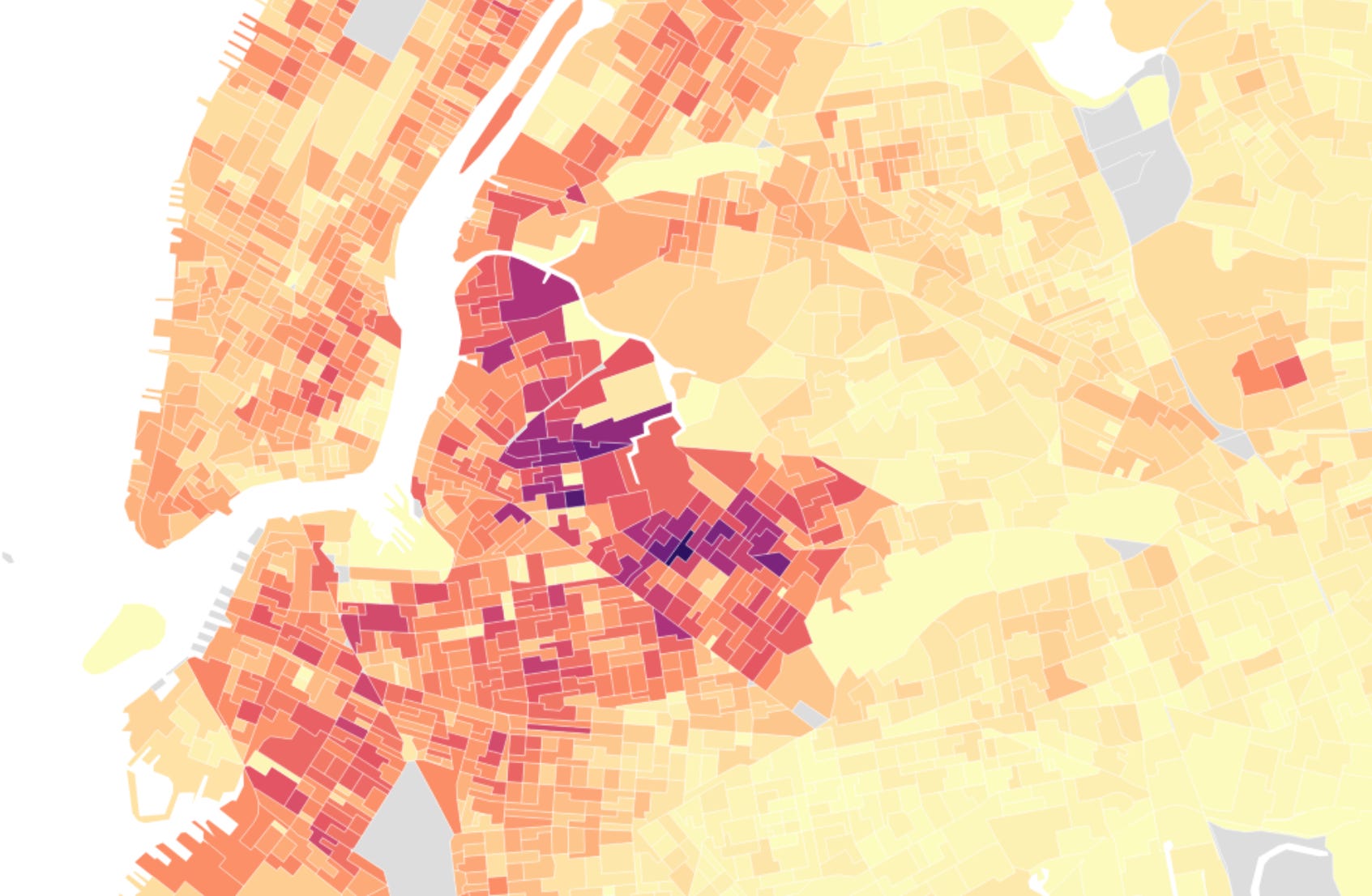
The map below shows a raw count of returning voters, not percentage share. Percentage share has some relevance, and we will get to it. But raw counts better capture what is most important at the precinct level: how consequential they were in the final tally. A precinct where fifty percent of twelve new voters came back is interesting; a precinct where one hundred came back, even at a lower rate, can be decisive.
The returning electorate is concentrated in the neighborhoods that have been half-jokingly, and now less jokingly, coined the Commie Corridor: western Queens, North Brooklyn, and the adjoining neighborhoods where Left politics has gradually made inroads.
Mayor Mamdani and NYC-DSA’s endorsees swept all contested races here, held the seats they were expected to hold and pushed the boundaries decisively outward. Eon Huntley unseated Stefani Zinerman in Bed-Stuy, Christian Celeste Tate ended the Dilan dynasty in Bushwick and Cypress Hills, and David Orkin bested Jenifer Rajkumar. All three were NYC-DSA endorsees lacking Mamdani’s endorsement. All three won by 15 points or more.
But district by district, block by block, did places with more returning 2025 first primary voters also vote more heavily for the candidates backed by Mamdani and NYC-DSA?
The interactive version of these charts is worth lingering over. Hover over a race in the color key to show only that district’s precincts. The cloud of data points is nowhere near identical in every race, because no two races were identical. Some were open seats, some were incumbent challenges, some had Mamdani’s endorsement, some only NYC-DSA’s, and some were fought on terrain where the old rules of New York politics still had more life in them than many wanted to admit.
There are also, as in any data set of this sort, artifacts. “First time 2025 primary voter” is not the same thing as “Mamdani voter,” let alone “socialist voter.” The 2025 primary brought new voters into the electorate for several reasons, including organized opposition to Mamdani. This is especially visible in the precincts clustered to the left of the NY-07, NY-10, and to a lesser extent, AD-56 charts: the Satmar Hasidim of South Williamsburg and Bed-Stuy, along with other Orthodox communities in Borough Park, who entered the 2025 primary electorate in larger numbers, but obviously not as part of a shared political project.
That does not weaken the finding. It may actually strengthen it. The returning electorate was hardly ideologically pure. It included those reached by Mamdani’s electorate expansion project and those assembled in opposition to it. Yet despite those countervailing precincts, a strong positive relationship persists.
That relationship becomes clearer when each district is reduced to the correlation among its precincts. This is a crude metric, necessarily. It cannot know why anyone came back, whether a campaign knocked their door, or what private combination of factors led people who showed up in 100 degree heat last June to return this year. It only asks one question: in each district, how closely did returning wave share track with the endorsee’s vote share?
For the statistics people: this is Pearson’s r, measuring the strength of the linear relationship between a precinct’s returning-wave share and the endorsee’s vote share. For everyone else: the farther right the dot, the more closely those two things moved together.
This is precinct-level analysis, not an individual-level model of voter behavior. It cannot by itself prove that the returning 2025 first-primary voters themselves voted for the endorsed candidates; it shows that places with higher returning wave share also tended to give those candidates higher vote shares.
The relationship is positive in every race, but it is strongest where NYC-DSA was operationally central to the campaign trail.
That distinction is important to draw. Mamdani’s endorsement helped define the public stakes of June 23, but an endorsement cannot will a field plan into existence. The returning electorate was most consequential where there was an organization capable of finding them, contacting them, and persuading them firmly at the helm.
This chart should also not be read as a metric of performance. AD-70 shows a strong correlation even though Conrad Blackburn lost. AD-34 shows the weakest one even though Brian Romero won in a landslide. Correlation here is easily overextrapolated. It tells us where the returning electorate tracked most closely with the candidate’s performance, not whether that performance was large enough to win by itself.
The idea of coattails is useful, but carries a somewhat passive connotation. A once-in-a-generation figure blazes the trail, and stragglers are carried across the line by his momentum. That is not quite what happened here.
Not every campaign won, nor did every new voter return. The old electorate was hardly swept into the sea. The old electorate is still here, voting consistently, and overrepresented in every low-turnout contest.
But it is no longer alone.
The next candidate who runs in New York City has to begin from that premise. As will the next incumbent deciding whether to retire or roll the dice. So do pollsters modeling a 2021 electorate and pretending nothing fundamental has changed.
The voters who came back in 2026 will not show up in every election at the same rate. But they now exist as a constant, dangerous possibility. Now that a primary has felt worthwhile to them as something other than a low-stakes event conducted by those same aging triple-primes, the city does not return to what it was before.
The permanent electorate is not a uniform bloc vote. It is not a constituency anyone owns, nor can it be mobilized without arduous work. But it is now an undeniable pressure on our political system. It alters the Overton window and win numbers and orderly succession plans. It makes old assumptions newly expensive. It means incumbents who once only had to survive the electorate they learned to expect now have to fear the electorate that might.
An electorate that made one strange June into two.
An electorate that has guaranteed the next time punditry says New York’s primary electorate is shallow, fixed, and beyond remaking, they will not be describing an inerrant law of our politics.
They will be describing the last version of it they understood.
I’ll be back in a few weeks for a series on the making of “patriotic populism.”
At Claire Valdez’s election night party, I made my accidental New York Post debut under the headline “The Young and the Clueless”— excellent earned media for The Hudson Line, if not quite how I imagined breaking into print.
First primary is an operational category, not the same thing as “first time voter.” It includes voters who had previously voted only in general elections. Of the voters whose first Democratic primary was in 2025, 216,966 had already voted in at least one prior general election, mostly in 2024. Another 66,134 appear to have cast their first recorded vote of any kind in the 2025 primary. Of the two, interestingly the latter returned in 2026 at a higher rate: 26.2% for the pure newcomers against 23.3% for those who had voted in a prior general.
There were two primaries in 2022. For this analysis, voting in either or both counts as participation in that year’s primary electorate.
fascinating, and wonderful analysis as always
There were clear "progressives" running with neither endorsement, SD-27 and CD-06 jump out. It would be interesting to get (at least those two) as a point of comparison. To what extent is this DSA? (large?) Mamdani? (large? larger?) NYC as a whole? (fascinating... I don't know... but I see some numbers that LOOK like surge for Park and Niou...
What makes those (and CD-13) more interesting is that they break out of the geographic confines...