

Washington is a city founded by people who believed, with very American confidence, that elaborate compromise could save them from the consequences of what they were unwilling to confront. We built our capital in a malarial swamp because slavers wanted a shorter commute and financiers wanted a centralized debt. A deal was struck: the Republic would govern from the Potomac. Within fifteen years, the British would raze it to the ground. Within fifty years, the water in the pipes had killed the most important man in the country three separate times. Washington has been making people live inside its bad premises ever since.
It was there, in the Rayburn Room of the Capitol, that Sarah McBride was sworn into Congress.
Her ascent need not detain us long, for this sort of ascent tends to rhyme. The lawyer father, the mother who founded the magnet school she would attend, American University, student government, campaign work— we know the type, and more than that we know the pipeline. McBride was too smart for the small pond that is Delaware, and Delaware, to its credit or its curse, is small enough to notice. By seventeen, she’d co-founded the state Young Democrats. By twenty-one she was Student Government president. She had staffed a gubernatorial campaign before she could vote for it. The Governor of Delaware, pointing to his desk, told her: “when this is your chair…”
McBride came out publicly in April 2012, in the student newspaper of American University the day after her term in student government lapsed. Beau and Joe Biden called her. Within weeks, she was at 1600 Pennsylvania for Pride Month festivities. Within months, she was interning at the White House’s Office of Public Engagement. Within a year, she was leading the lobbying effort that would pass Delaware’s gender identity nondiscrimination law by a single vote in the State Senate. The velocity of it all— the way her already robust political capital converted almost instantly into a new kind of representative authority— tells you something about that particular moment. This was the early 2010s. Things were opening up. Obama had just endorsed gay marriage. The Democratic establishment was discovering, with a kind of exuberant self-regard, its capacity for acceptance. It is easy to forget how recent and how contingent all of that was.
What followed was an iteration of the career she would have had anyway, refracted: advocacy groups, HRC press secretary, the suburban State Senate seat. She passed a paid family leave law in Delaware that had nothing to do with being trans. She passed a Medicaid expansion that had nothing to do with being trans. She was, and always has been, a normie Democrat of above-average talent in a state small enough to reward it. The fact that she was trans was the most important thing about her and also, in the daily texture of her work, rarely the point at all. This is a tension the rest of the country has never quite figured out what to do with.
I am a trans woman, a fact that no conceivable future success, disgrace, reinvention, or ordinary happiness will keep out of the first line or two written about me when I die.
This is not melodrama. It is an observation of the grammar of public life. There are many categories one can inhabit with some hope of strategic management. Class can be disguised or overstated. Religion can be lost, found, softened, embraced, inherited only in aesthetics, or rendered into anecdote. Even sexuality, at least for some, has in certain eras permitted tactical silence, a double life, a partitioning of the self into public and private worlds. But transness, once established as a socially legible fact, has a brutally adhesive character. It sticks to the name. It inserts itself where otherwise it might have been only incidental. One may write beautifully or badly, win office or lose it, marry, embarrass oneself, age into a settled peace, feel secure in a profession, become obscure, become insufferable, but much of the story is pre-written.
This is not because it is always, in some metaphysical or Sisyphean struggle sense, the deepest truth about a person. Very often it is not. But the culture insists. It insists because it wants to know what box the story belongs in. It insists because these base characteristics are, for institutions of narrative, immensely useful sorting structures. It insists because if a trans woman has done anything of note, there is still a tacit editorial conviction that the reader must first be told what kind of creature she was. Even admiration can take this form— especially admiration.
You either learn to carry the weight of the descriptor, or you don’t. The weight is not constant. Some days, it is nothing. Some days, it is synonymous with your entire personhood. The trick is to do your best— and best is not perfect— to choose which days are which, and not let anyone else.
McBride, it must be said, carries it well. Too well, in some estimations.
A peculiarity of today’s anti-trans backlash is that it has not entirely reproduced the cultural pattern seen in earlier backlashes against Black advancement or women’s liberation. There has been no full-throated return of the old freakshow caricature to the center of prestige culture, no obvious new pop culture canon of trans monstrosity of the kind earlier eras’ racist and misogynistic reaction were happy to supply. The Silence of the Lambs could not be made today. What we get instead is tabloid fixation on any crime, fraud, or grotesqueness involving a transgender woman, plus the ever-expanding mythos of the hulking trans athlete. The backslide takes place more quietly now: on the legislature floor, in the courts, and in letterhead .pdfs no one actually reads.
This means the backlash needed an avatar. Not a monster— the tabloids have enough of those, few newsworthy beyond a single story— but a subject, someone whose existence could be made to stand in for a whole set of anxieties that are easier to feel than to articulate. An elected official is ideal for this. An elected official who is the first is perfect. And a first who is also, by temperament and training, a mainstream, coalition-building moderate Democrat is the most confounding object of all.
Nancy Mace understood the assignment, or at least its crudest version. Within two weeks of McBride’s election, Mace introduced a resolution to ban transgender women from using the women’s restrooms at the Capitol. She confirmed it was aimed at McBride specifically. She used language that her colleagues and media were happy to amplify. Marjorie Taylor Greene said it didn’t go far enough. Speaker Johnson issued a formal policy banning transgender women from facilities throughout the Capitol complex, covering not only members but staff, journalists, and visitors. The message was acute: you may be a duly elected representative of your entire state, but the terms of your presence here will be dictated by us. Mace’s campaign for South Carolina governor has not seen much of a polling bump.
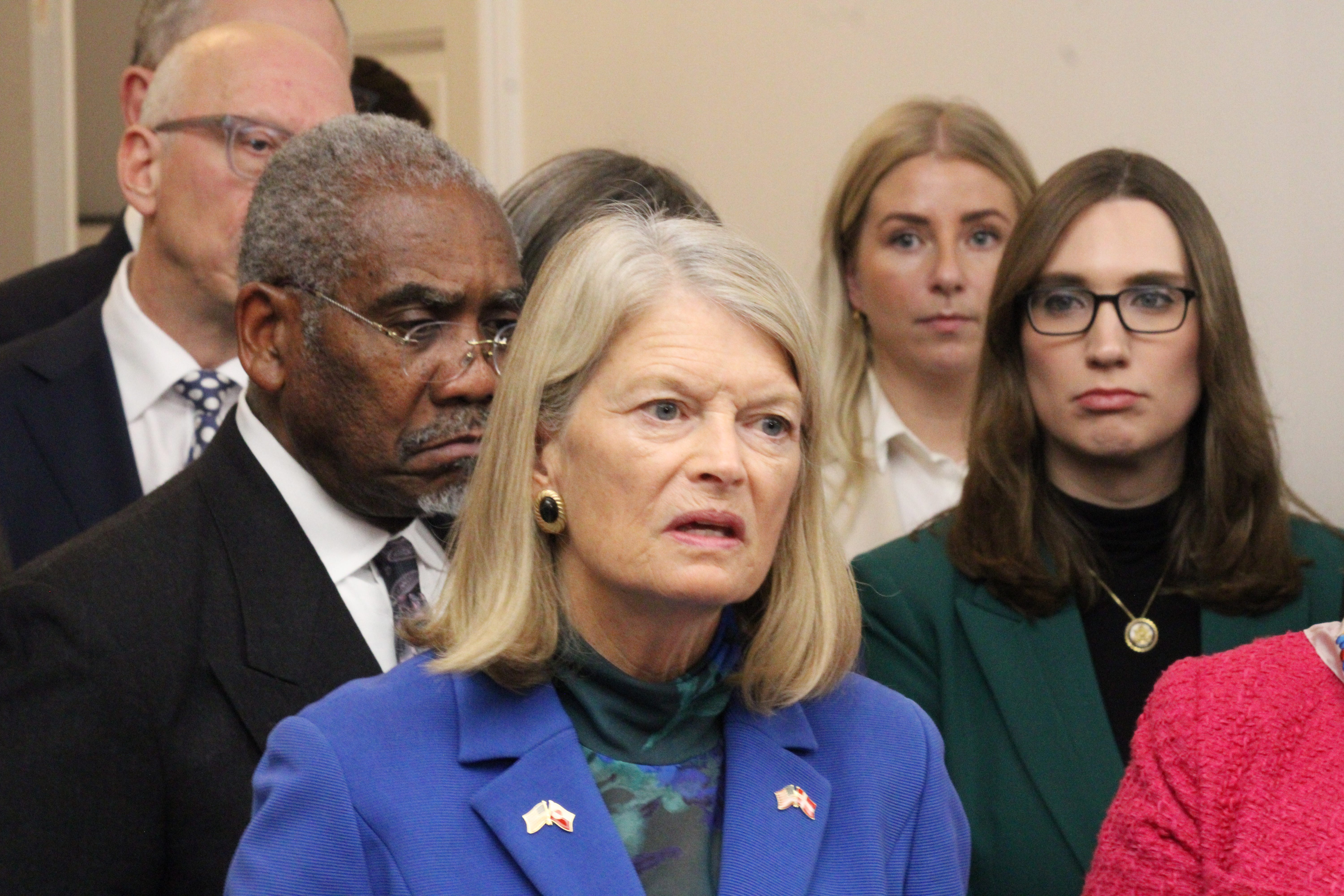
McBride’s response was somewhat avoidant. “I’m not here to fight about bathrooms. I’m here to fight for Delawareans and to bring down costs facing families.” She would follow the Speaker’s rules, even if she disagreed with them. She introduced the FAIR Leave Act. She joined the Foreign Affairs Committee. She traveled to Copenhagen as part of a bipartisan delegation signaling we are not, we hope, invading Greenland. She was, in every visible way, a normal freshman legislator pursuing the normal freshman legislator’s track, and this drove everyone a little crazy.
There is a certain kind of trans person— and I say that as someone who has been this kind of trans person— for whom McBride’s composure registers not as strategy but as betrayal. The logic runs roughly like so: the moment is catastrophic, basic rights are disappearing, and your one person inside the building, the sole representative like you in the legislature of the most powerful country on Earth, is… introducing a paid leave bill, going to Denmark, and on Ezra Klein under the title “Sarah McBride on Why The Left Lost on Trans Rights.”
That feeling is not irrational. It is, in fact, a guttural emotional registration of a real political condition: having a tribune who is not, in the ways that would feel most urgent, actually a tribune at all. McBride did not run as the tribune of the trans. She ran to represent Delaware. The distinction is not trivial, but neither is it consoling, especially when the figure in question is also— unavoidably— the only one available to absorb the full weight of that symbolic function.
The trouble with firsts is that they are asked to do two things at once: to perform the normalcy that justifies their presence and to embody the exceptionality that makes their presence— even in a bad moment— historic. McBride cannot simply be Delaware’s congresswoman. She is, whether she wants to be or not, a proof of concept. Every bill she introduces, every hearing she attends, every bathroom she does or does not use, carries the secondary freight of demonstration. And the people for whom that demonstration matters most— trans people watching from outside the building, in states and in a country that is squeezing them— are precisely the ones most likely to feel that the demonstration is insufficient. That it answers the wrong question. That I can do the normal thing is a less urgent sentence than I will fight the abnormal thing that is happening to us.
The criticism is understandable, but it misidentifies the problem. The problem is not McBride’s temperament. The problem is the structural position of a single freshman in a body of 435, whose party does not hold the majority, during a period of coordinated legal and executive assault on the rights of people like her. The range of her available options is not vast. She can introduce bills that will not pass. She can make floor speeches. She can cajole anti-trans policy out of omnibus bills as she has. She can call the policies immoral as she has. She can serve as a familiar face to politicians who may otherwise moderate as she has— most notably her relationship with Joe Biden. She can be misgendered on the House floor by the presiding member— twice, by two different Republicans, in two different hearings— and respond with a dry correction or a satirical correction or no correction at all. What she cannot do is stop the whole machinery of American anti-trans politics.
By 2024, the Democratic Party’s relationship to trans people had acquired the abstract, dissociated quality of a lab exercise. One of the better accidental parables of this is that Kamala Harris had reportedly decided that, if asked, she would say she opposed “men in women’s sports.” The detail is almost too perfect. Not simply the position, though it is craven enough, but the form of it: if asked. It is difficult not to picture it as Harris did, sometime in the choreography of a losing campaign: the skeptical interviewer, the momentary pause, the utterance of difficult candor by which she would demonstrate that she was, after all, one of the serious people. A tiny profile in courage, every beat focus-grouped. The only problem was that her campaign was so hermetically sealed off from journalists that the question was not asked. That Churchillian hour went unrendered.
Harris wrote afterward, in the obligatory post-election memoir, that she wished she had done more to counter the attacks. That she had concerns but broadly supported the community. She harkens back to the use of same-sex marriage as a wedge in 2004. The comparison is apt and unintentionally devastating: in 2004, Democrats rebuked gay marriage while feeling quite bad about it; twenty years later, the party had progressed to dodging questions on trans people while feeling quite bad about it. The arc of the moral universe is long, and it bends towards postmortems that age better.
This is the water McBride swims in. A party that will include her, celebrate her, let her speak from the podium at the 2016 convention, and then, when the cost comes due, treat her and everyone like her as a line item in a budget to be negotiated. A party whose leaders will, in the privacy of the campaign, rehearse the positions they would take if only the conditions were right.
One reason the fantasy of a singular trans public is so unstable is that it does not map neatly onto most of the divisions through which contemporary politics usually understands people. The trust-fund daughter and the uninsured gig worker may both be trans. So may the Black schoolteacher, the rabbi, the Midwestern nursing student, the City Hall bureaucrat, the woman in prison, the corporate lawyer, the suburban teenager with indulgent parents, the rural one who does her best to square the circle, the older divorcée with grown children. The category is real. But it refuses the tidy lines we tend to draw.
This cannot be said to be exceptional. Someone who has peculiar standing to say so pointed out to me that “we aren’t a monolith” is what all social groups— especially narrativized social groups— say. She’s right. But if every social group says it, the saying of it is both commonplace and persistently necessary— which suggests that the monolith keeps getting reassembled from the outside no matter how many times it is disclaimed from within. Trans people say we are not a monolith because the outer world keeps insisting we are one, keeps needing us to be one, keeps projecting as many of us do onto one woman in a Capitol office a coherence she cannot possibly possess.
McBride did not choose this role. She chose to run for Congress, and in doing so, has been made the representative of a constituency that does not, in any politically actionable sense, exist as one. There is no trans voting bloc large enough to demand favor. There is no actionable trans legislative agenda in this moment and even when there is, will not be one for some time in most of the states. There are trans people who need healthcare and trans people who need to not be fired and trans people who need the state to stop tightening the noose and trans people who are, for the moment, fine. What they share is a name and a vulnerability, and what the name does, in the current political paradigm, is make that vulnerability available for exploitation by people who understand that a marginal population is the ideal surface onto which a frightened country can project its undifferentiated rage.
I do not think she is the right person to lead a movement. I am not sure she thinks so either. But she is the person who is there, in the room, doing her job. The question is not whether McBride is adequate to the crisis. No single legislator could be. The question is what we do with the fact that in this moment of maximum danger, the system has produced exactly one of her— one person, in one seat, in one chamber, in one branch— and asked her to hold. Hold as every moderation is read as cowardice and every assertion is read as aggression; hold as the people who need her most will be the ones most disappointed by what she is in practice able to do.
She is holding the line, in her own way. Whether it is enough is a question she cannot answer and we should not expect her to.