

At eleven o’clock on the morning of February 20, 1861, Fernando Wood stood in the Governor’s Room at City Hall. He was waiting for Abraham Lincoln. The police1 had chained off the approach to the stairs. Lincoln had spent the night across Broadway at the Astor House, had breakfast with city businessmen uptown, and returned around ten. There he met Joshua Dewey, a 94-year-old veteran of the Revolutionary War, before making his way across Broadway. The men upstairs knew he had reached City Hall when they heard shouting outside.
A reporter thought the appearance of the two men was “most striking.” Wood stood on one side of a table and Lincoln on the other. Both wore black. Wood kept his eyes fixed on Lincoln throughout, and Lincoln, “taller by the head,” stared back. Around them stood the Common Council and the city press.
Anyone who has watched Steven Spielberg’s Lincoln knows Wood as one of America’s preeminent bastards: the pro-slavery New York congressman Lee Pace plays cross-examining Thaddeus Stevens across the House chamber. In February 1861 he was mayor, and a month earlier he had proposed that New York secede from the Union— creating an American Venice of Manhattan, Staten Island, and Long Island he called the “Free City of Tri-Insula.”
Fernando Wood could make a case for it with ease. After all, ships came and left New York Harbor for the rest of the known world. Its stevedores and warehousemen moved Southern cotton. About two-thirds of all federal revenue was collected at its port. A quarrel among states hundreds of miles away could devastate the city’s economy. And yet New York was helpless, one city of many in the State of New York, an arrangement Wood spent much of his political life openly resenting.
By this February morning, Wood had tidied his language. New York’s material interests had been paralyzed by the sectional crisis, he told Lincoln. The city was the “child of the American Union,” and its commercial greatness was at risk of disappearing with the country that had produced it. Lincoln knew most New Yorkers had voted against him, and said so. He thanked them for receiving him anyway and stated plainly he would not willingly consent to the destruction of the Union under which New York and the country had acquired their greatness.
Nothing was settled in the Governor’s Room, and so the episode is now obscure. Then came the reception. Lincoln shook hands. Among those who came through were about twenty veterans of the War of 1812. He shook hands with a man from South Carolina “for the Union.” One man declared that he was as tall as Lincoln. They stood back to back, with Wood acting as judge.
“[Lincoln is] an inch the tallest.”
“I thought so, I’m hard to beat.”
Another man came forward. Lincoln asked his height and conceded the point immediately. This one was taller.2 As the reception came to a close, the doors to the balcony were thrown open. Lincoln appeared above City Hall Park, where thousands had gathered below. The crowd looked up. Then he gave an impromptu speech. Back in the Governor’s Room, he spent a few minutes lingering among the ghosts on canvas— presidents and governors, mayors and generals, Washington and Lafayette among them— before leaving. Wood went on to Congress, Lincoln went on to the White House, and the country continued barreling toward war.
New York is the city of cities, and America the nation of nations.
For a few days every September this becomes visible from the sidewalks of the East Side. Diplomatic plates pepper the streets. Two little flags appear on the hoods of cars. Hotels fill with security details, and men in suits wearing lanyards around their necks loiter outside their gilded doors. Cardinals stream onto Park Avenue after Mass. Barricades appear on streets that were open just the previous night. First Avenue acquires a new traffic code for the week, apparently known only to the men and women standing in the intersections enforcing it. Behind one of those tinted windows speeding by could be someone who, some other place, is the ruler of all.
When I lived off of 51st and First, I carried an IDNYC. Every September it simplified a recurring conversation with the NYPD: yes, I live on this block; indeed, I would like to go home; and, being fourteen, could I stop halfway down it when Trump rolled by in “the Beast” to record the motorcade? While navigating the maze, I learned to read the two-letter country codes on diplomatic plates.
New York makes an odd neutral ground. Besides diplomacy, New York is the principal city of world finance, of media, and of culture.3 It sits inside the world’s most powerful country; Manhattan is dense in a way Geneva and Davos and the rest are decidedly not, yet the United Nations Headquarters ended up here, and so the East Side is dotted with a second city of missions, consulates, and international offices. Some of the people who arrive with these delegations stay and become New Yorkers. Many more of their citizens do the same by less glamorous means. Those New Yorkers can live in city public housing, have their children taught in city schools, have the city police their streets, and be treated in city hospitals. Yet Washington is the final arbiter of who can and cannot stay, and Albany in turn dictates the limits on what the city may do for them.
This gives the Mayor of New York an unusual default prominence abroad. And yet Mayor Mamdani is no ordinary mayor. Long before he was sworn in on January 1, people far outside New York had already assigned his impending mayoralty meanings that had little to do with the City Charter.
A few weeks after the primary, at the DSA convention in Chicago, I was pulled into a conversation between various people who worked on his campaign and a group of German observers who wanted to know exactly how we had done it. There were pens and notebooks and Germans nodding while furiously clacking away on laptops. I was there as NYC-DSA’s Electoral Research & Data Co-Chair, a title I was elected to a month after Mamdani launched. By Chicago I knew considerably more about how the campaign operated than I had in its infancy. This had somehow left me with little confidence that I understood why it worked.
We talked about voter files and targeting and field, about things that had seemed worth a try when implemented and newly consequential only after they had worked. Mostly we came to the conclusion that quite a lot of it would be impossible under European privacy law.
This did not stop the world from trying to figure out which parts could travel. Through the summer, delegations of various international parties with long acronyms came through NYC-DSA’s tiny Jefferson Street office, while politicians abroad began invoking Mamdani in arguments over rent, transit, and the cost of ordinary life.
Last week Die Linke won 25.7% in the Berlin state election and finished first. The next day Elif Eralp called Mamdani’s success “a big example for us.” Berlin, she was sure to add, remained a different city with a different political system.
The weekend before world leaders descended on New York for the United Nations General Assembly, 25 mayors and other city officials from 34 cities worldwide came to New York for the Urban 20 summit. It was a meeting of cities, immediately before the meeting of nations. They met at Civic Hall and Gracie Mansion and, most delightfully, rode through the city on top of a double-decker tour bus. They adopted a communiqué asking national governments to give cities more authority and resources— principally in areas of housing, climate, and immigration. The national governments came to town the next day.
Come Monday, Mamdani went to the residence of Brazil’s Permanent Representative to the United Nations, where President Luiz Inácio Lula da Silva was staying during General Assembly week. They talked about the cost of living and exchanged soccer jerseys: Corinthians from Lula, a New York City4 jersey from Mamdani. Later that afternoon, the President of the United States came to Gracie Mansion, the first sitting president to visit Gracie since Reagan visited Ed Koch in 1981.
At their first Oval Office meeting in November, Trump paused near the end of the press conference, mildly exasperated, to remark that meetings with leaders of major countries did not seem to attract anything like the interest surrounding today’s meeting. The press, he said, had gone crazy for Mamdani.
In April, someone asked Mamdani whether Trump might prove as useful to him as Franklin Roosevelt had been to La Guardia. Mamdani answered by talking about Sunnyside Yard. If you are to build 12,000 apartments, create 30,000 jobs to build them over a vast rail yard in Queens, you need Washington.
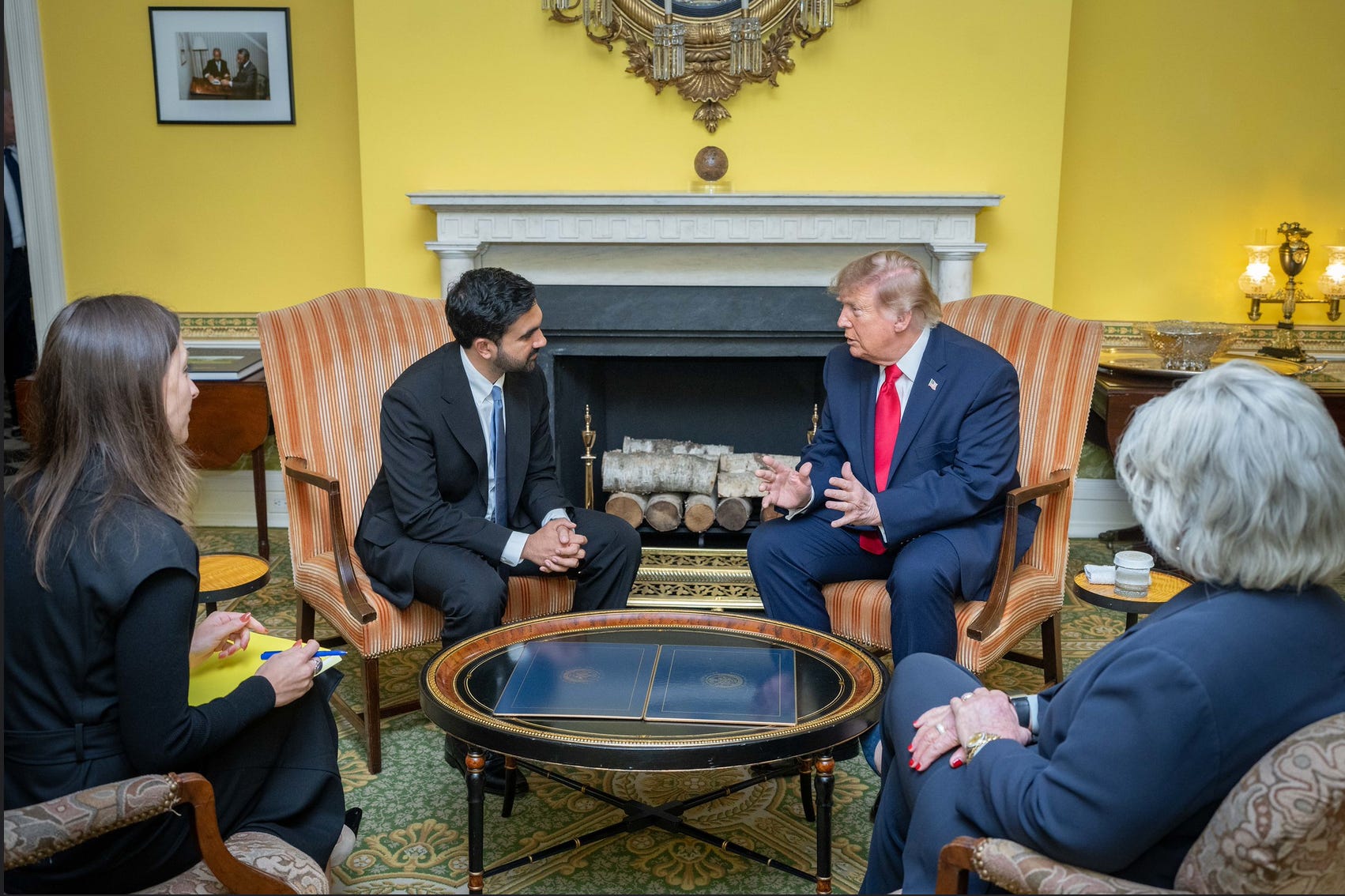
Mamdani invited Trump to Gracie Mansion. A photograph shows the two men seated around a glass table in the Yellow Parlor with Susie Wiles and Elle Bisgaard-Church. Mamdani and Bisgaard-Church, seated on the left of the table, wore black. Trump and Wiles, on the right, navy blue. Mamdani showed him a cannonball from the Revolutionary War and a fireplace grafted onto Gracie from the house where Alexander Hamilton died.
Outside, reporters were trying to discern what all of this meant.
What exactly had Mamdani gained? Why invite Trump? Was he doing his best to not aggravate the president? Had the meeting gotten New York anything on immigration? Why did the two politicians who disagreed on nearly every issue under the sun seem to get along in person? And what is with Mamdani’s stoic facial expression during the presser?
Trump said that he wanted Mamdani to be a great mayor. Mamdani then thanked him for coming. And, repeatedly from the podium, Mamdani steered the Q&A back to Sunnyside Yard.
Also mentioned from the meeting was the revocation of Temporary Protected Status for Haitians fleeing the gangs that occupy much of Port-au-Prince. Entire neighborhoods have been razed to the ground and continue to be. Many of the survivors now sleep on flattened cardboard in crowded shelters around the city. The federal government announced the termination of Haiti’s TPS designation in November, with litigation reaching the Supreme Court, and the termination took effect in July. Mamdani later said that he tried to plead the case for re-designating Haiti to Trump through affected New Yorkers he had spoken to— the Haitian families who now lack work authorization and protections against deportation, as well as their religious leaders and employers. Trump meanwhile at the podium made it known that Mamdani clearly cared deeply about the issue. Asked if he would change anything, Trump gave no indication that he would.
Asked what use there was in maintaining the relationship while ICE raids continued, Mamdani recalled a meeting at the White House in February where he raised the names of several New York college students who were being detained by DHS to Trump. About half an hour later, Trump called to tell him that one of them, Columbia student Ellie Aghayeva, would be released.
Days previous, Trump had barred CNN, MS NOW, and Politico from White House grounds, leading in turn to a boycott of pooled television coverage at the White House. Mamdani told him that those outlets would be welcome to Gracie Mansion, and they were. When reporters asked Trump about it outside, he defended the decision to bar news outlets.
Gracie Mansion, as he put it, is a special house. The White House, however, is the most special house.
For once, Gracie Mansion got to set the rules.
The next day, Norwegian prime minister Jonas Gahr Støre went with Mamdani to P.S. 059 Beekman Hill International, ten or so blocks up from the United Nations. The schedule noted the topic as LLM use in schools, Norway and New York having both recently established guardrails on their use by younger students.
A kindergarten girl told Mamdani that she had never met a mayor.
“Have you ever met a prime minister?” he asked.
No.
Mamdani gestured Støre over.
By midweek, Pedro Sánchez and Mia Mottley had come to be received by the mayor, along with António Costa, the president of the European Council, who a decade earlier had been the mayor of Lisbon. Costa told the breakfast that Mamdani had “the best job that a politician can do.” As mayor, he said, you could learn of a problem in the morning and have it fixed before the day was over.
Two days earlier, Mamdani had spent an hour with the President of the United States talking about Sunnyside Yard. Trump remarked that New Yorkers had been trying to build there for fifty years. Their staffs will keep talking.
In December 2024, before pollsters had even bothered to include him, much less “at 1% in the polls,” Mamdani had said that if Benjamin Netanyahu came to New York, the city would execute the International Criminal Court’s warrant and arrest him. Once Mamdani became mayor, city lawyers concluded that New York had no independent authority to do so. Mamdani released a video asking the federal government to make the arrest instead.
And so Netanyahu is here. As I write this paragraph, twenty blocks north, several hundred protesters— including elected officials and soon-to-be elected officials— are sitting in the street trying to block his passage. The NYPD will arrest them instead. He will then likely take a shot at Mamdani from the podium, that or I will remove this sentence.5 Last night, Mamdani ate dinner with Palestinian New Yorkers and refugees from Gaza at Gracie Mansion and planted an olive tree with them on the porch. The video released this morning before Netanyahu’s speech also shows Mamdani pouring water for one of his guests, an older woman in a hijab. It ends: “an olive tree grows in Gracie.”
Fernando Wood did not get his Free City. He did get Central Park— 843 acres in the middle of Manhattan, realized as originally envisioned in no small part because of his veto of the Common Council. Yet when he is remembered today, if he is remembered at all, it is mostly for other things.
This week Mamdani received presidents and prime ministers. He took Norway’s prime minister to kindergarten and the Dutch prime minister to meet LGBT youth. He exchanged soccer jerseys with Lula. He took the Taoiseach of Ireland on the G train, where an ecstatic woman approached for a photograph. Micheál Martin scooted over a seat; she took the photo with the mayor alone. He met with Austria’s president and the British foreign secretary. He had breakfast with people whose other appointments concerned wars, nations, and the global economy.
And somewhere between all of this remained Sunnyside Yard. Can New York actually get twelve thousand apartments built over it?
Next week, like clockwork, the motorcades will be gone; the little flags on the hoods of cars will go with them. First Avenue will return to something approximating its normal rules. The city will remain exactly where it has been: between Washington, Albany, and everywhere else— as it was, is now, and ever shall be.
World without end.
A brief housekeeping note:
The Hudson Line passed 1,000 subscribers this week. I’m enormously grateful. Thank you, sincerely, to each and every one of you.
The Metropolitan Police, created by the state legislature over Wood’s opposition. Four years earlier they had arrested him at City Hall, though not before Wood’s Municipal Police fought them in the streets. The courts ultimately upheld Albany’s authority and Wood dissolved the Municipal Police. City police would remain state-controlled until 1870.
Nineteenth-century reporters had a habit of recording details that would probably be omitted from a modern account: who stood where, how they were dressed, their body language, even impromptu challengers to Abraham Lincoln’s height. We have transcripts and video now, and perhaps reporters consequently feel less necessity to put this kind of thing in print. I am grateful they once did.
These are statements of fact.
Not an MLS jersey of New York City Football Club or the New Jersey Energy Drinks. The problem was sidestepped with one of the municipal-boostery ones that sold out in under an hour at CityStore. Austria’s president got one too. Before CityStore had even opened, the line was massive and I can count. I am not aggrieved by this. Were I truly aggrieved, I would be trying to become president of either Brazil or Austria.
He did.
(Smiling 🙂) I live on 25th street and First Avenue, the UN meeting is disruptive, closed streets, gridlock, adding to the normal traffic chaos… for the Mayor of days of worldwide spotlights, mixing with world leaders, and Donald, his new bro.
Yes, candidates are mirroring the Mamdani campaign, with success, the mayor is still struggling with his 9 to 5 job, governing. His choice of school chancellor, a disaster, agencies bickering among themselves, ten % of students living in shelters and on and on.
His plan to speed up traffic by designing more bus only lanes adds to gridlock.
His battle with teachers union alienates black and Hispanic women, who who see the mayor as opposing not supporting their “pay boost.”
The glow of rubbing elbows with world leaders fades quickly, the annoyance of those daily decisions and internecine battles within his administration dominate his governance, and, budgetary woes linger.
Is Mamdani a model for the DSA and young progressive candidates? Will he challenge AOC for social media face time?
Or, fade as NYC is dragged down by mundane realities of governing?