

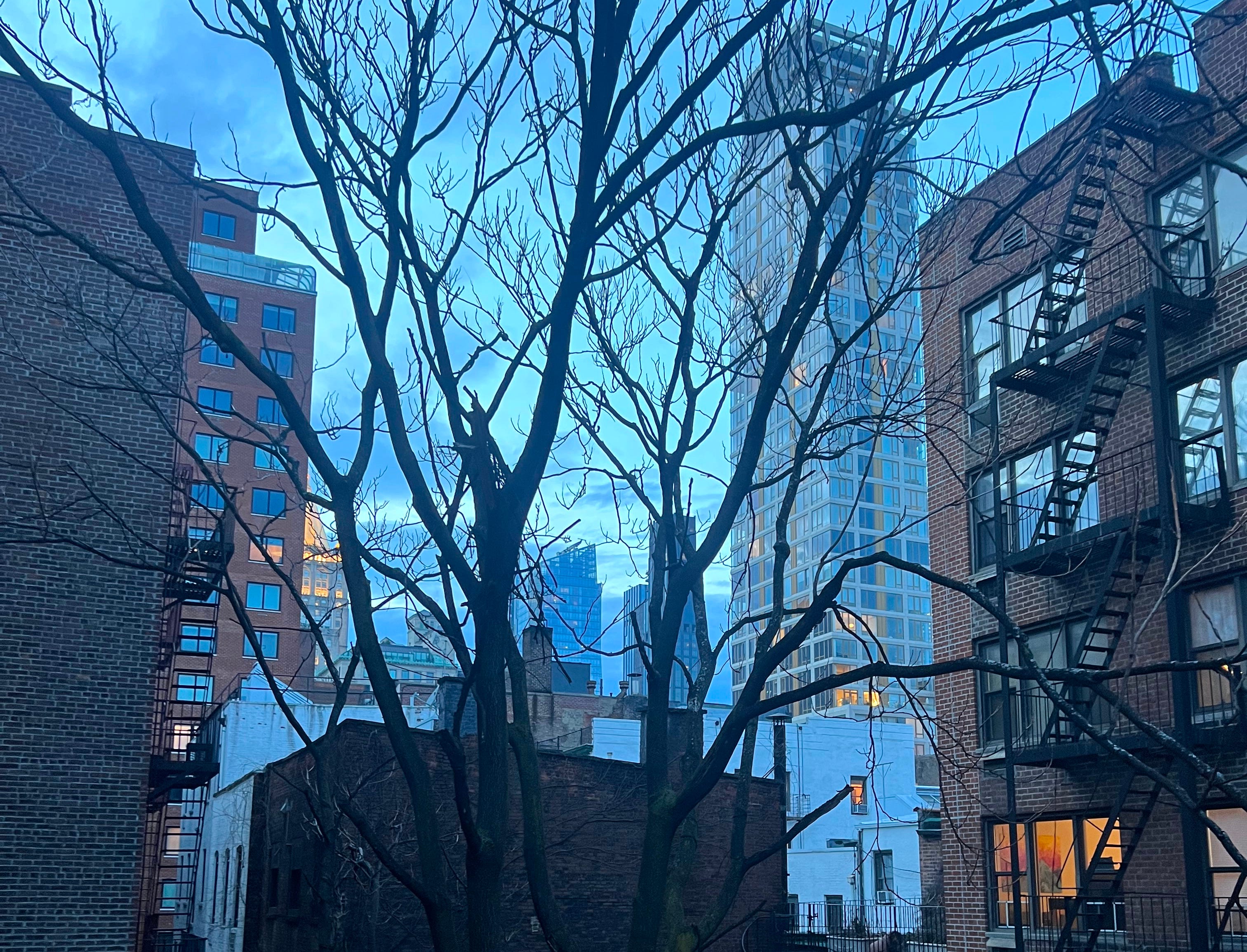
The crime of changing my name in the eyes of the Board of Elections has wiped my electoral history clean. I am registered in NY-12, I have voted here on and off since high school, and yet as far as some $9.39 million in Democratic spending is concerned— I do not exist. No mailers. No glossy pitches or digs at this candidate’s employment or that candidate’s voting record. The banks found me. The student loan people found me. Democracy, regrettably, has not.
This has left me in the somewhat absurd position of being a political obsessive in the singularly most educated, fifth highest-income congressional district in the country, and yet receiving essentially no outreach. I do not have cable. I pay for YouTube Premium because I am a pushover and hate advertisements. Instead, I get the race in fragments: clips of candidate forums on Twitter, chatter in Signal chats, City & State pieces, and the drip-drip-drip of New York Playbook.
Which may actually be the right way to encounter New York’s Twelfth. You see, this district is simultaneously the smallest geographically in the country and the least accessible. This is Midtown Manhattan— the de facto capital of America, though it bears little resemblance. Ever tried canvassing a doorman building? I have. The median rent in Manhattan is $5,524— an absurdly unattainable number, though through the three-and-a-half people per bedroom reality of my middle and high school years on the Upper East Side and later Midtown East, to the guest bedroom in Kips Bay I have occupied for the last eighteen months and write from today, I have repeatedly and almost entirely accidentally managed to remain here.
Legibility here instead comes from a convoluted system of mediated cues. Who is up from the Democratic clubs. Who has endorsements from the people who matter— or matter to the people who matter. Who has always been around. Who has the record. Who most clearly has what it takes in this current moment among the healthy stock of very serious people.
Yet here in the land of graduate degrees and bylined opinion, nobody seems entirely sure what kind of Democrat is supposed to come next.
For a very long time, it was Jerry Nadler.
He grew up in Bensonhurst in the ‘50s and ‘60s— except for a stint at his father’s Jersey chicken farm. After Crown Heights Yeshiva, Nadler— long the only member of Congress with a yeshiva background— ended up exactly where the brightest of our city are supposed to: Stuyvesant High. There he rubbed shoulders with a slew of other budding political stars. From there onward to Columbia, Fordham for law, and then in 1976 the State Assembly for the Upper West Side.
Funny thing: before Jerry Nadler was an institution, he was once a member of a very different NYC-DSA.
Not this one (I am on the organizing committee of today’s Lower Manhattan DSA)— not the sprawling machine of spreadsheet tacticians, endorsement fights, and citywide ambition that those three letters immediately call to mind, but its older, stranger ancestor. This was Michael Harrington’s outfit of bookish reformists, labor intellectuals, a holdover of a once vibrant Jewish social democratic tradition that while waning had clear, clubbish fluency in not rupture but a cleaner civic ethic: proving, patiently and procedurally, that good-government was attainable. This was the DSA of Ruth Messinger and a younger Brad Lander.
Nadler was formed in that world, and it never quite left him.
He spent the ‘80s running for higher office against various other known names— David Dinkins for Borough President, Elizabeth Holtzman for Comptroller— and losing each time. His opening came instead through death: Congressman Ted Weiss died one day before the 1992 primary, and Nadler was chosen to inherit a district which would remain more or less his turf until 2022— Manhattan’s West Side, and then a long, improbable snake through Brooklyn to Borough Park and Bensonhurst.
Awkwardly drawn, yes, but one of the last coherent political expressions of Jewish New York. On the northern end sat the Upper West Side: secular, professional, a twinge artsy, crowded with lawyers, professors, reformers, and a center of gravity orbiting all around civic participation. On the other sat southern Brooklyn, Orthodox Jewish exclaves of his youth where political life was less about ideology than communal assurance, institutional relationships, and who knew whom. Nadler’s life almost perfectly straddles both worlds.
Across Central Park would lie a district with a different raison d’être. It was a world of Upper East Side country club stock and outer-borough go-getters, of prep schools and parochial schools, of hospitals and train yards. These patricians and white-ethnics would that same year choose a different representative in Carolyn Maloney, a North Carolina native married to an investment banker who represented Latino East Harlem and would defeat Manhattan’s last Republican congressperson.
Maloney’s district, though seldom less Democratic in the end, ran on a different fuel. From the co-ops and brownstones between the Park and the East River, then over the Queensboro into Long Island City and Astoria before those neighborhoods became shorthand for something younger and more self-conscious. It tethered old money to postwar immigrants, silk-stocking liberalism to the upwardly mobile children of cops, firefighters, and mechanics. It was not a district of fading social democracy and Orthodox institutional barter, but of preservation battles, prestige fundraisers, the unseen hum of industry, and in Maloney a kind of respectable seriousness that could use the word “reform” without ever quite threatening the stark social hierarchy that produced it. It would also become something of a timebomb as western Queens and northern Brooklyn became more professional, more transplanted; a phenomenon coroneted by Maloney being held to 42.7% of the vote against Suraj Patel and a more lefty spoiler candidate in 2020.
The next cycle, both districts would cease to exist.
New York redistricting had long been a grubby exercise in bipartisan self-preservation— Democrats for decades accepted maps that helped keep Republicans afloat in the State Senate, and in the post-IDC, post-Cuomo climate of 2022 attempted a far more aggressive gerrymander. This opened the door to judicial humiliation. The maps were thrown out, a court took over, and in their place emerged something cleaner on paper and stranger in practice: a Twelfth straddling Midtown from 14th Street to 96th. Incumbents be damned: Nadler and Maloney would vie for the same district.
To put it bluntly, not all fights are fair. Much to my shame as an East Sider— and my relief as a progressive East Sider— the West Side turns out, and in Manhattan the West Sider usually wins. Take roll of our Borough Presidents and District Attorneys and you find, with few exceptions, West Siders. Nadler entered the race with that civic muscle at his back: stronger club infrastructure, denser habits of participation, a more vibrant political culture. Maloney, meanwhile, was plainly bruised from Suraj Patel’s near-upset two years prior, and Patel’s decision to run again for this new district only deepened the sense that her coalition was fraying.
And yet to live through it did not feel like watching an inevitability assert itself.
Maloney led the first public poll 31-21. She entered with more money, stacked more endorsements. Even when Nadler passed her in the polls, it was by single digits in all but the final. The structural advantage was real; so was the uncertainty. This was not one of those races where everyone quietly foresaw the result and merely waited for the ballots to affirm it. It felt messier than that, more interpersonally fraught than that: a district that while more homogenous than the ‘90s iteration of Midtown I described did not yet see itself as cohesive.
It was a rout. Nadler 55.4%, Maloney 24.4%, Patel 19.2%.
Nadler, to his credit or merely his instinct for survival, did not spend his final act pretending that nothing had changed. The Gaza war cracked open the old Manhattan liberal Zionist consensus more forcefully than any issue in years, and even he— product of that vanished civic world, steward of its habits and syntax— was forced onto more uncertain ground, calling for a ceasefire in a political language that was no longer entirely his own. With his protégé Scott Stringer reduced to an afterthought and his district split between Cuomo in the first round and Mamdani in the final, the choice before him became difficult to evade.
By the time he endorsed now-Mayor Mamdani in the general election, the gesture, while generous, read less as conversion than concession: an acknowledgement that the kind of Democrat Jerry Nadler had spent a lifetime embodying could no longer, by itself, answer the city emerging around him. Cuomo would carry NY-12 come November.
The field is crowded in a specifically New York manner: over-credentialed, media-literate, faintly ridiculous, full of people whose candidacies seem at once inevitable and strangely precarious. They are institutional heirs, never-Trumpers, a Kennedy scion, and no less than two Michael Cohens, neither of whom ultimately ran.
What makes the field feel so odd is that none of the candidates are really offering a continuation of Nadlerism, but neither are they proposing anything coherent enough to qualify as a clean break. Instead, they offer competing theories of succession. Lasher comes closest to institutional continuity, but the institution itself has thinned out. Bores offers technocratic fluency in an electorate for the first time threatened by the march of technological progress. Schlossberg offers dynastic glamour in a moment where the Kennedys are having their Diana moment. Conway offers anti-Trumpism after anti-Trumpism has decisively lost. What this district is choosing, in other words, is less a political future than the social style in which it would like to receive one. Not only who replaces Nadler, but what kind of elite Democratic legitimacy can still hold this district together.
The nearest thing the race had to an obvious break from all this was Cameron Kasky, who arrived not from the clubs or the legislature or a family of note, but from a more random pipeline: national moral celebrity. A Parkland survivor who moved from March For Our Lives to the Yang Gang and into this race as its clearest progressive and most openly pro-Palestine candidate, he imagined a narrow path: a plurality in an exceptionally split field. The theory for it was elegant; the constituency less clear. After a visit to the West Bank, he dropped out in January.
Kasky’s exit left the field to candidates more fluent in Manhattan’s established forms of legitimacy, perhaps none more so than Micah Lasher. If the district still retains any instinct towards direct continuity, it will largely settle in his direction. Nadler endorsed him. Bloomberg is spending for him. The clubs know him. West Side pols speak in unison: that if there is to be a respectable succession here, it ought to pass through Lasher.
On paper, this may seem strange. Lasher is a first-term assemblymember, but this fact belies a quarter century marinating in New York politics. Another Stuy alumnus, he managed Brad Hoylman’s first council campaign and advised Scott Stringer as a teenager, worked for Nadler, legislative affairs in Bloomberg’s City Hall, a failed bid to succeed Adriano Espaillat in the State Senate, and director of policy under Governor Hochul. He had a Times profile at 28. What can look like precocity is, in fact, something more settled: a life spent moving precisely through the institutions this district still knows to recognize as seriousness.
For those of a certain age— I include myself here— the feeling is less awe than recognition of how early this city teaches its favorites to seem inevitable.
If Lasher can trace his lineage most cleanly to Nadler, Alex Bores is the candidate of the East Side, and trying very hard not to be so. Maloney’s endorsement has only made that old East-West split explicit again. But Bores, while representing the most monied west-of-Third splint of the Upper East Side in the Assembly, has framed himself as something else entirely. A computer scientist with a stint at Palantir behind him, he has spent his time in the Assembly making himself Albany’s AI guy, including through a notable partnership with State Senator Kristen Gonzalez— NYC-DSA’s own former tech worker.
Together they have proposed consumer-protection standards, transparency requirements, and provenance rules meant to place guardrails around the emerging technology rather than simply reject it or pretend it can be ignored. It is a fitting candidacy for the moment: an electorate anxious that the future their own class helped midwife may be coming for them next.
That posture has not gone unanswered. If Lasher’s legitimacy comes through endorsements and West Side clubs, Bores’ has been tested by something more contemporary: a flood of outside money treating a Manhattan congressional primary as a referendum on whether artificial intelligence will answer to democratic politics at all. A pro-AI PAC hit him with $120k in negative ads in December, $326k in January, much of it centered on his time at Palantir; by February, the spending against him had swelled past $1 million. Maloney, in endorsing him, seized on the obvious counterpoint.
But for all Bores’ effort to register as something other than the cursed East Side candidate, he has also assembled the most conspicuously post-local coalition in the race: only 12% of his donations came from inside the district, while Berkeley alone accounted for 17%.
Then there is Jack Schlossberg— government name John Bouvier Kennedy Schlossberg— whose candidacy feels old and strangely new at once. He is young, though at 33 not quite young enough to excuse the extent to which he comes prepackaged: Yale, Harvard, Vogue, the only grandson of John F. Kennedy and a card-carrying member of the American Windsors in the time of Robert F. Kennedy, Jr.’s spectacular desecration of their mythology.
What makes Schlossberg especially interesting is not the regality of the thing, but the anxiety that now trails short behind. The Kennedy name is today pockmarked. Decades of producing awe from Carnegie Hill to Bed-Stuy, but now also equally capable of conjuring vaccine skeptical crankery, anti-trans fearmongering, and splintered family denunciation. Schlossberg’s apparition here therefore carries a tension more layered than a simple ‘60s throwback. He is a test of whether Clan Kennedy can still, in the Year of Our Lord Two Thousand and Twenty-Six, produce a politician who feels more like inheritance than dissonance.
That tension is stronger still because Schlossberg does not present as the restoration of some don’t-rock-the-boat, more decorous strain that is most Kennedy’s artform. He presents, rather, as a very contemporary mutation: polished credentials, erratic in medium, trying to defend Camelot through the same algorithmic attention economy that has already marred the family. The fear— seldom stated outright, though New York Magazine gets closest— is not that he might or likely will fail. It is that he might become another kind of Kennedy embarrassment altogether: not the apostasy of RFK Jr., but the crass, self-branding, internet-brained heir who cannot quite square the difference between salvaging the family image and jetting it into the content mill.
For a district like this one, of course, this may not be disqualifying. It wasn’t for Speaker Emerita Pelosi or his own mother Caroline. It may in fact render him more alluring. Schlossberg’s candidacy asks whether, in a field crowded with both Errol Louis and Anderson Cooper regulars, there remains appetite for something at once grander and far rockier: a man whose pitch is less as inheritor to a robust political tradition than an ability to cross-stitch what remains.
Conway, meanwhile, represents a different strain entirely: the never-Trumpers who became liberals, or whatever exactly liberals become in a moment like this. A decade ago, Conway’s profile might have read simply: Republican litigator, Federalist Society alum husband to Kellyanne, fixture of a certain Washington legal world rubbing shoulders with Ann Coulter and Matt Drudge and Brett Kavanaugh during the Clinton impeachment. He belonged to that ilk in its leaner, more self-satisfied phase, when the pedigreed Right cast itself as a meritocratic counter-establishment of clerks, judges, and ultimately legalistic dominance. They won on the last point.
Trump shattered that self-mystique, or at least made it impossible to maintain without apprehension. The splitters were not exactly ideologically reborn, but politically transubstantiated: the conservative power lawyer turned resistance celebrity, the husband of Trump’s campaign manager turned cable-frequenting guard of the Republic. His language is thick with talk of the rule of law, accountability, democratic norms, beating back Trump’s rubber-stamp majority, making his final two years living hell— all of it intelligible, and all of it a 2018 vintage. He is running, in fewer words, not on a theory of what Congress can do in any aspirational sense but on staving the bleeding.
That thinness is not incidental; it is the campaign. Conway is not really offering the district a legislative imagination so much as a battle stance of permanent injunction— he will object loudly, litigiously, and with maximum professional credibility to the immutable presence of Donald J. Trump. He’s vague on his other positions. In another universe, the role might just as easily have gone to the disbarred fixer Michael D. Cohen— a more recent convert, far gaudier, and with vastly more direct complicity, but ultimately auditioning for the same anti-Trump monoculture.
Not a single poll at time of publication has been independent. Lasher and Bores, intuitive frontrunners to analysts from Politico to The Hudson Line, do not yet register that perceived strength. A consistent third of the electorate is clocked undecided, and as fun as it may be to predict the truth of the matter is that there remains little to go on.

Trump’s second presidency has had a curious effect on elite Democratic politics, both clarifying and destabilizing it. The old reactive anti-Trump consensus still structures the emotional life of the Twelfth, but so too does the growing sense that it is no longer enough. Two competing philosophies of how to proceed most recently squared off in the Mayoral race, and few places were more ambivalent. Two and a half months into governance, Mayor Mamdani’s approvals now sit comfortably over 50% in the district, with about a quarter disapproving and a fifth unsure.
And yet the field has been notably slower to absorb this shift than the district itself. If Mamdani’s growing comfort here suggests that even the Twelfth’s most prestige-conscious voters are becoming more receptive to a politics that promises more than procedural resistance and expert containment, little in the race quite reflects it.
This is not a bug so much as the defining feature of this place. The Twelfth is not ever where the next phase of national Democratic politics is discovered in its rawest form. It is where such politics, having already emerged elsewhere and survived its first encounters with fear, ridicule, and institutional avoidance, is wedded to figures who embody a more respectable form of ascent in one way or another.
This district does not invent the future but interrogates it: who has vouched for it, whether it can speak in a more acceptable register, whether its rougher edges can be sanded down into something fit to be accepted as stable continuity. That is not an indictment exactly, just a fact of being not often put to page. What may look, in a cycle like this one, like a failure of imagination is in fact closer to a social function.
That is why none of the candidates really sound like they belong to the phase of Democratic politics this city and perhaps the country at-large seems to be entering. They sound instead like interpreters, mediators, or containment vessels for it. Even the most forward-looking amongst them tend to phrase things not through rupture but effective management; not a new governing instinct so much as assurance that whatever realities are now forcing themselves onto stage, can be handled by the proper people, in the proper institutions, in the proper cadence.
The question that faces the Twelfth, then, is not what current will carry the Midterms or even the next Presidential race. The city has begun to answer that elsewhere. The question is what version of that politics will take hold here.
A a 12th CD voter (and fellow Substack-er) and political junkie a few thoughts. In my work life I worked for a labor union, in the days when clubs had captains on every block. If you wanted a pothole in front of your house filled you contacted your district leader, the days of retail politics.
Clubs today are powerless (except for judgeships), my current club in the 12th holds meetings, endorses candidates and has minimal impact.
My neighbors were engaged in the mayoral primaries and general, Cuomo or Mamdani, probably split.
I sat through interviews six of the candidates giving their five minute spiel: I asked if the Dems won would they support Jeffries for speaker? A few had no idea what I was talking about and a few they’d decide if they’ve won.
Most still think Maloney and Holyman are still representing them.
Will Bloomberg’s 5M to Lasher seal it up, or piss off further left voters?
Will Mamdani’s foot soldiers knock on doors for. ??
Btw, does it matter who wins? a freshman, in a 435 member legislative body doesn’t exactly have clout,